Part 19: Deadly Encounter at Mt. Willing
The bloody autumn air of late 1781 carried the scent of woodsmoke and turned earth across the rolling hills of Mount Willing, South Carolina. Cornwallis had surrendered at Yorktown, but in the backcountry the war had only grown more bitter – and more personal.
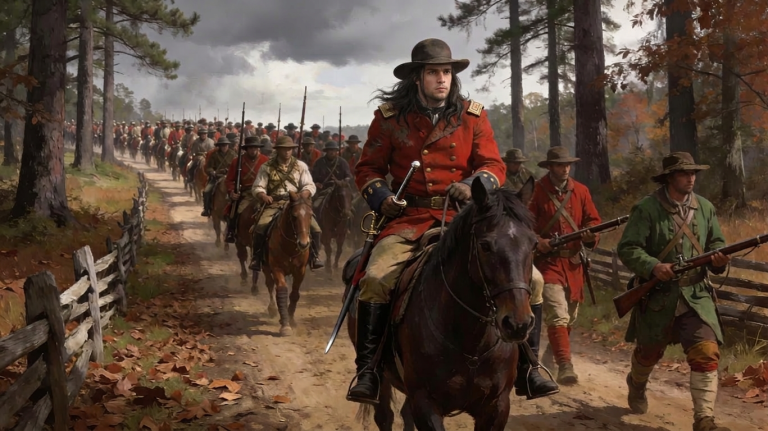
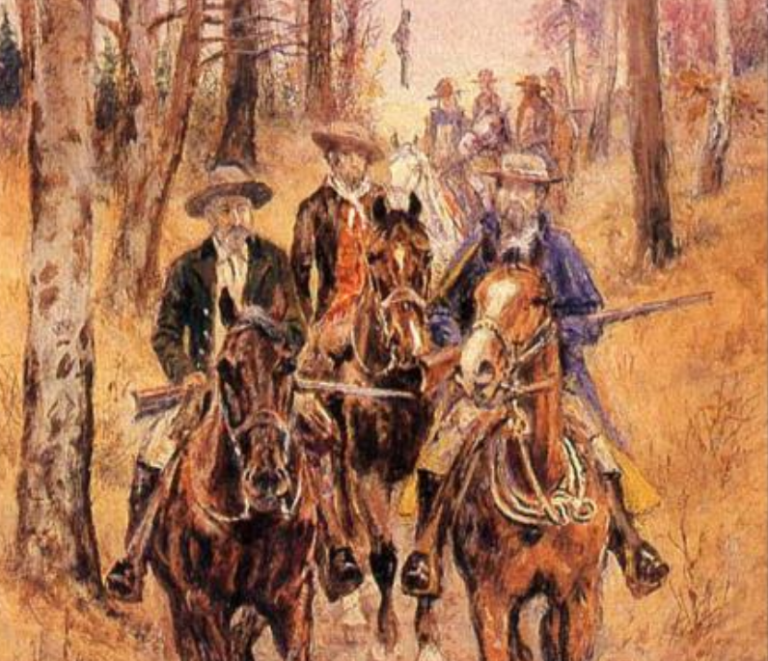
Major William Cunningham’s Loyalist scouts—about three hundred strong. Many of them came from bitter exile nursing old grievances, as had Cunningham, himself. They had turned the district into a hunting ground.
He had divided his force: one part rode with him, the other under Colonel Hezekiah Williams. Cunningham’s close friend, Captain William Radcliffe, rode with Williams. Radcliffe, lean and sharp-eyed, led a fast detachment of a dozen hand-picked riders. They would peel away from Williams from time-to-time when when a lightning fast attack was called for.
Cunningham’s scouts struck at dusk or at first light, whenever patriot families relaxed their guard. Farms were stripped, livestock vanished into the pines. Sometimes women and children watched their barns, even homes, burn.
Captain Sterling Turner’s small patriot command had been shadowing Radcliffe’s raiders for weeks. He kept his men light and mobile, rarely more than twenty in the saddle, riding from homestead to homestead to blunt Cunningham’s advance. Among them was young Jim Butler, just turned twenty and already hardened by two years of skirmishing. He had ridden with Turner since spring, learning every creek, ridge, and sand road along the Saluda and the Little Saluda, and all the creeks in between.
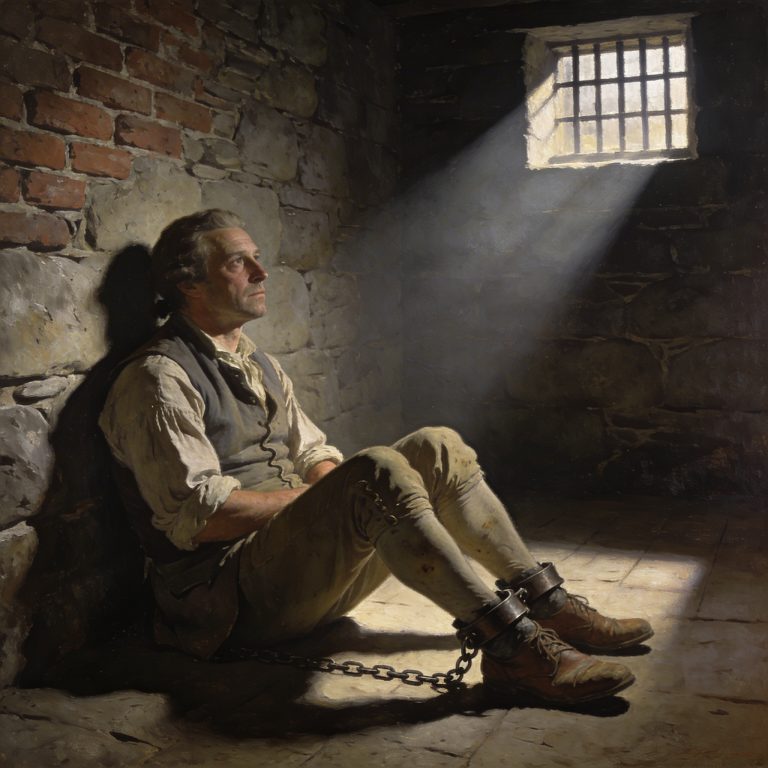
When news came that Captain James Butler, long imprisoned in the Provost at Charles Town, had at last been released and had made his way home, Jim Butler took leave to see him. That evening, beside a small pine-wood fire, Jim urged his father to rejoin the cause.
The elder Butler, gaunt and hollow-eyed, sat wrapped in a blanket, staring into the flames. “I’ve done my part, son,” he said quietly. “The cause has had its pound of flesh. All I want now is to sit on my porch with your mother and watch the corn come in.”
Jim knelt beside him, voice low and urgent. “They’re burning us out, Pa. Radcliffe’s bunch hit the Smith place two nights ago—took every horse, left the barn in ashes. Turner says we’re the only ones between them and half the families in Mount Willing. You don’t have to fight. Just ride with us. Advise. That’s all I’m asking.”
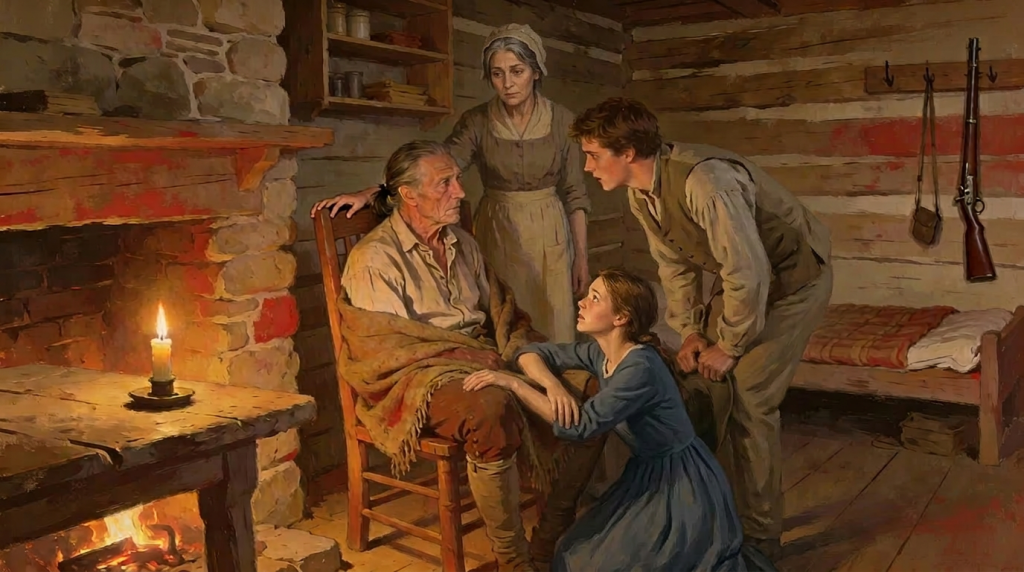
Butler looked into the eager eyes of his son – always the firebrand of the family. He knew his own knowledge of the ground and the men who fought over it was too valuable to waste when it might help keep his son safe. He agreed to ride as an adviser for a short time, intending to return to his family once the immediate danger had passed.
One last patrol for the Patriot cause.
In the gray light of the following morning, father and son met up with Turner who had been following fresh hoofmarks north, west, and then back toward Mount Willing. Deep-cut prints of shod hooves marked the soft clay—evidence of men riding hard and confident. The trail twisted through thin pine woods and shallow gullies toward a narrow hollow where two small branches met before running down to the river. Turner signaled a halt and studied the ground.
Below, at the water’s edge, a small party of Loyalists had halted to water their horses, no more than fifteen men, stripped down for speed. It was Radcliffe’s “flying squad.” He sat straight in the saddle in a faded green jacket, tricorn pulled low, carbine resting easily across his pommel. Even at a distance his relaxed posture spoke of a man used to moving unchallenged through hostile country.
Turner’s men slipped from their saddles and fanned out along the ridge, easing into the scrub for cover.
Butler Sr., watching the scene with the practiced eye of an old partisan, picked out the sentry on the far bank and the likely avenues of escape. At Turner’s signal, two of the best marksmen worked down the creek bed to remove the lookout while the rest of the line waited with leveled rifles.
The opening shot fractured the quiet hollow. The sentry toppled from his horse into the brush. For a heartbeat the Loyalists hesitated; then the clearing erupted with motion. Radcliffe wheeled, shouted orders, and raised his carbine. His men scrambled for such cover as the banks and scattered trees allowed, firing as they ran. Bullets clipped branches and hummed through the scrub around Turner’s line.
Turner’s men answered with a controlled volley that checked the Loyalist rush and dropped more than one of Radcliffe’s riders in the churned mud. Seeing the ambush for what it was, Radcliffe chose to strike rather than flee. Rallying the men nearest him, he spurred straight toward the firing guns, saber glinting in the flat morning light.
The two lines met in a brief, violent clash at the creek crossing. Jim Butler drove his horse into the melee, pistol in hand, while his father hung back, calling out corrections and warnings, guiding Turner’s men by instinct and memory of a hundred small fights. In the chaos at the ford, several of Turner’s men, including Jim Butler, found a shot and put a ball toward Radcliffe. The Loyalist officer rocked in the saddle, still clinging to his mount long enough to fire once more before dropping to the ground, mortally wounded.
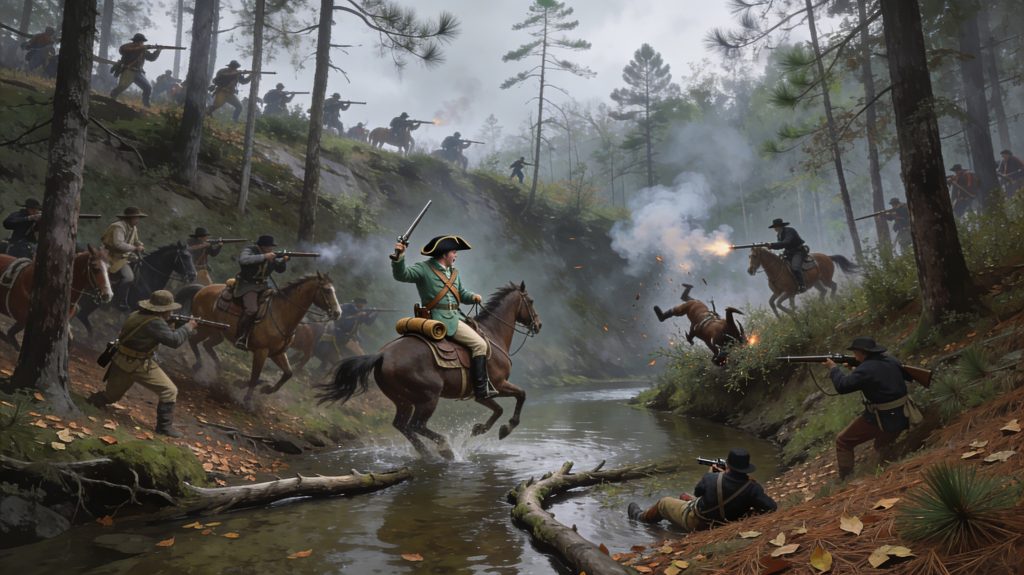
Jim Butler was closest to Radcliffe when he fell, suggesting that he was the one who fired the fatal shot. But, in truth, no one ever knew exactly who triggered that bullet.
The skirmish near Mount Willing was over almost as quickly as it had begun. Radcliffe had toppled into the waterlogged clay. Around him, several of his men lay where they had fallen; the rest, seeing their leader down and the ground lost, broke for the timber and vanished into the pines. Turner’s riders gave a brief pursuit, then reined in.
The chase would wait until the dead were buried.
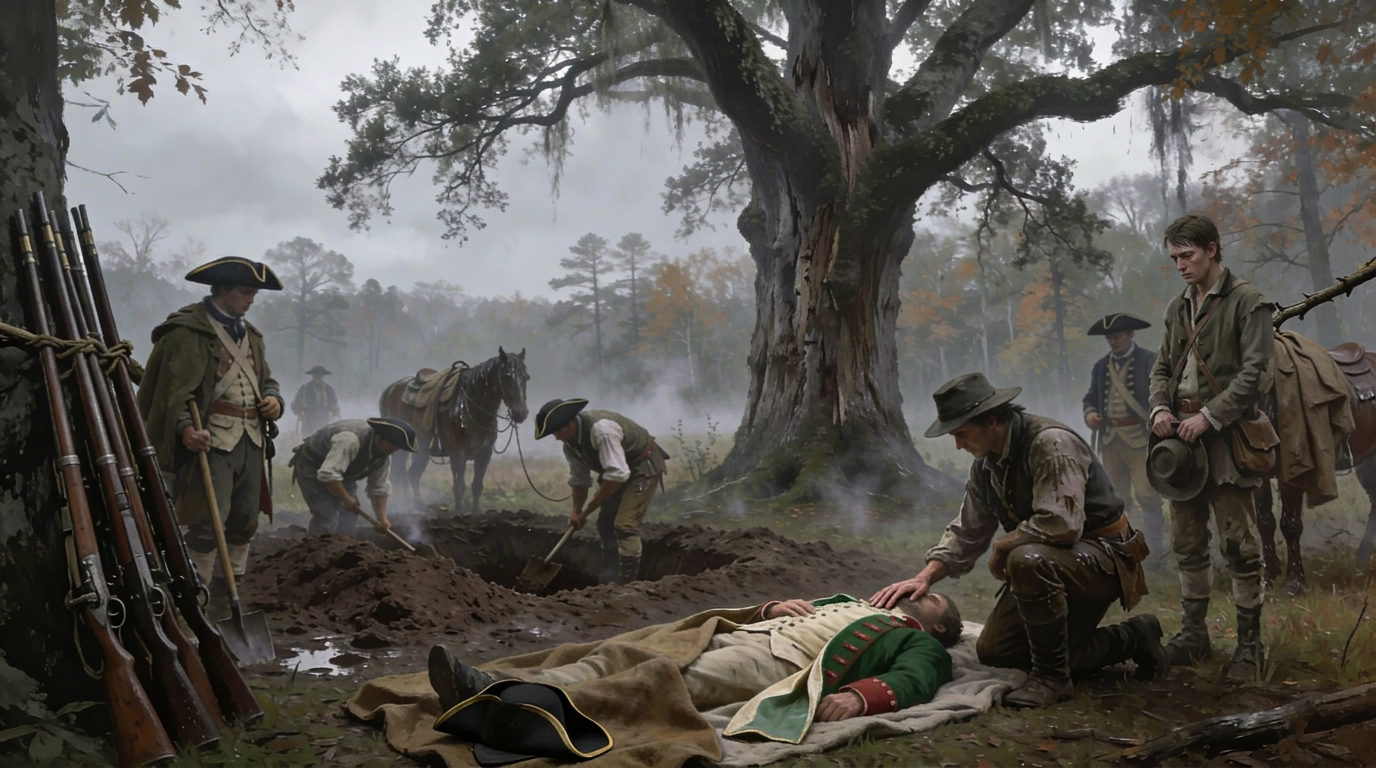
Butler Sr. stood over Radcliffe’s body in the silenced hollow. It was not the first time Butler had looked soberly at the waste of war. The young officer’s eyes were fixed on the low, colorless sky, his breath gone to a thin rattle and then to nothing. Turner’s men gathered weapons, cartridges, and such gear as they could use, then dug a shallow graves near a lightning-scarred oak and laid Radcliffe and the others to rest without ceremony.
It was the rough courtesy of men who knew they might soon lie in similar ground.
Radcliffe’s flying column was broken, but Williams was still abroad with his larger party. Turner turned his attention eastward. He and his men forded the Little Saluda and angled across the rough country toward Tarrar’s Spring, following rumors of driven cattle and frightened settlers. Their route took them along and over the branches of the Little Saluda, through sandhills and scrub oak, past creeks that would later be fixed on maps as Cloud’s Creek and Big Lick. Day by day they pressed Williams, closing the distance.
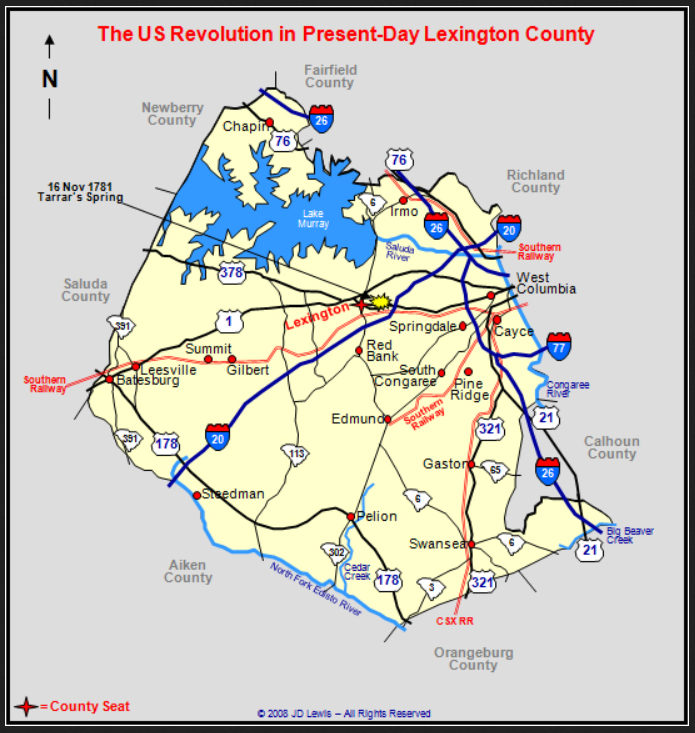
Turner’s men finally found Colonel Williams’ detachment near Tarrar’s Spring- just about a mile west of today’s downtown Lexington. Shots flared in the woods and along the lines of the stolen cattle they were herding. It was an indecisive clash in poor ground and worsening weather. As rain began to fall, both parties were cold, hungry, and burdened by the stock they trailed.
In the end, negotiations prevailed. Williams surrendered the stolen cattle and withdrew with his men, while Turner turned his own command back toward home.
It was a moral victory, but it did not end Cunningham’s campaign.
The weather worsened at Turner’s men headed back west. A hard, steady rain swept in from the west, turning sandy tracks and clay roads alike into red mire. The men rode, soaked and shivering, their powder at constant risk of ruin, the horses slipped on treacherous slopes as they followed the bends of the Little Saluda back toward Mount Willing.
As dusk was closing in, the weary militia approached an abandoned cabin near Cloud’s Creek. The Carter family, themselves, were gone, having sought refuge weeks before at a nearby blockhouse when Cunningham’s riders first swept through the district. Their furniture, a few tools, and a scattering of nervous cattle remained as mute evidence of their absence.
Turner’s men, exhausted from days of pursuit and the fight at Tarrar’s Spring, looked to the empty cabin with undisguised longing. Horses stumbled from weariness; men’s shoulders sagged under wet coats and damp cartridge boxes. The place offered a roof, a hearth, and at least the chance to dry powder and rest the mounts.
Captain Butler, remembering too many tales of patrols caught under shelter, judged the risk against the condition of the command. The country around Cloud’s Creek was contested ground, and Cunningham’s main body could not be far away. Yet the men were in no state to ride all night through deepening mud and heavy rain.
In the end, necessity carried the argument. Turner ordered the horses under the Carter lean‑to and posted strong guards along the approaches to the cabin and the creek. Inside, the men coaxed a fire to life in the hearth, steam rising from sodden coats and boots as they spread out blankets on the rough plank floor. Weapons were wiped down and set near the heat in hopes of restoring them to serviceable condition by morning.
Jim Butler sat close to the flames, the memory of Radcliffe’s fall still sharp in his mind. His father moved from post to post, checking the sentries at the door and along the darkened edge of the yard, listening to the ceaseless drumming of the rain on the Carter roof.
Outside, Cloud’s Creek swelled in the darkness, carrying leaves and broken branches down toward the Little Saluda.
Somewhere beyond the reach of the cabin’s faint light, Cunningham was already learning of the death of his longtime friend, William Radcliffe. Word was that young Jim Butler was the one who killed him. Anger combined with the grief upon hearing of Colonel Williams’s humiliation at Tarrar’s Spring – surrendering livestock to the much smaller patriot band.
But back at Cloud’s Creek, that small patriot party took some relief, sheltering – just for one night – in an empty homestead on a rising creek.
The cost of that brief respite would soon be measured in blood.