Part 17: The Southern Campaign
In the summer of 1780, only a few short months after the victory at Charles Town, the hopes of the British high command turned to the South as the key to crushing the American Revolution.
General Lord Cornwallis was the principal British field commander of the Continental Army in the Carolinas and, later, in Virginia. Cornwallis believed that if he could break resistance in Georgia and the Carolinas, he could march north through a chain of relatively “pacified” provinces and strangle the rebellion from its weakest flank.
He got off to a brilliant start in Camden, thanks to a disastrous performance by Continental Army General, Horatio Gates. This firsthand account from Private Royal Jennings1 of Virginia tells the story:
[Jennings] states that he was in the Battle of Gates’ [Gen. Horatio Gates’s] defeat near Camden, South Carolina [16 Aug 1780] He states that from Charlotte [Virginia] we marched to Hillsboro [sic: Hillsborough] North Carolina then we waited nearly a month for the northern county Virginia militia.
After the two Regiments had got togeather Gen’l Gates from the main army arrived about the first of August and reviewed the army and ordered the Officers of our Regiment to meet him at Rougeleys Mills [sic: Rugeley’s Mill in SC] by such a time (meaning a certain time) within six miles of Campden and the time was so short that we were allowed to get to Rougeleys Mills that we were compelled to march until twelve oclock every night the weather being both rainy and hot and we were supported upon half and quarter rations.
He states that when we arrived at Rougeleys Mills Gen’l Gates took command of the army and we joined the Baron De Kalb with his regulars and the North Carolina Militia. We arrived about twelve oclock in the day [15 Aug] at Rougeleys Mills and were ordered to wash and fix ourselves and be ready to march by eight oclock that night to Campden to attack Lord Cornwallis. We did so.
We marched about half way to Campden as was supposed when the advanced Infantry met the advanced Infantry of the British [at about 2 AM] and the advanced Infantry of the British fired upon the advanced Infantry of the Americans and a pretty smart scermishing was kept up until day. About sunrise our army was put in order of Battle.
We were ordered not to fire until we could see the whites of their eyes. The Virginia troops were formed on the left wing towards Campden along the side of the road about 90 or 100 yards from the road. The British had to extend their files six or eight feet in order to flank with us.
While we were standing waiting for the British to advance on us and for orders to fire we heard the British Officers give the command to their army to wheel about and fire on us. They did so and our soldiers could not stand that but immediately fired upon them without orders Then the British began and the whole army was engaged. My Capt Thomas Williams was wounded in the shoulder.
The British charged upon us and we gave way, but kept up a constant fireing until we retreated to a Swamp that was near us when Tarlton [Lt. Col. Banister Tarleton’s Legion] charged upon us with his horse and we were compelled to make the best way we could through the swamp.
The Battle lasted about two hours and we sustained a complete defeat.
At this Battle the Baron DeKalb was mortally wounded and died in a few [three] days after as I understood.
At this Battle Gen’l Gates behaved most shamefully betaking himself to flight in the first of the fighting and left the Baron De Kalb to fight the Battle. The arm[y] was completely put to route and fled in consternation and confusion in every direction.
In short, Horatio Gates led a half-starved and badly arranged army against Cornwallis and suffered one of the worst defeats of the war.
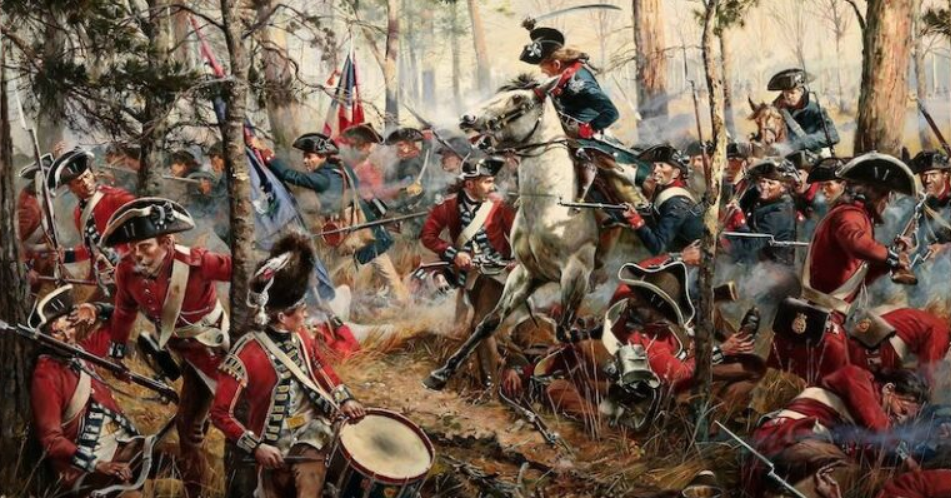
From that wreckage, it seemed the British had secured the South.
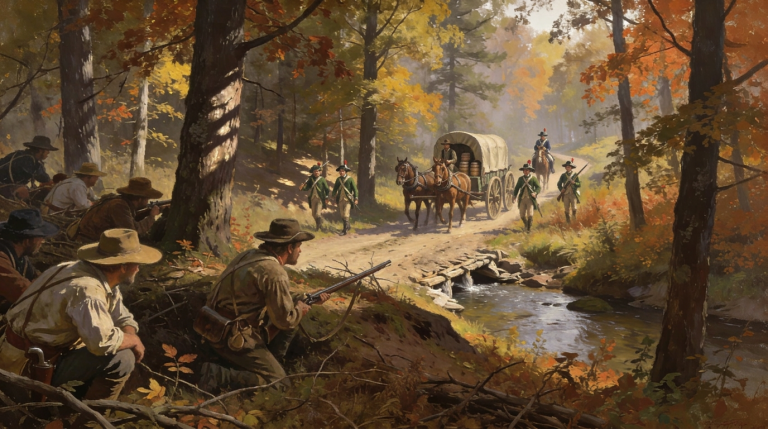
Yet, the Southern backcountry refused to stay conquered. In a brutal civil war of Patriot against Loyalist, a chain of hard-fought actions began to bleed Cornwallis’s army.
At King’s Mountain, frontier riflemen, including Captain William Butler, shattered Major Patrick Ferguson’s Loyalist corps, destroying one wing of Cornwallis’s advance. Patrick and William Cunningham fought on the Loyalist side.
King’s Mountain was entirely won by Patriot Militia.
In late 1780, after King’s Mountain, Horatio Gates replacement, General Nathaniel Greene, arrived and began rebuilding the demoralized Continental Army and local militia. William Butler served under Greene.
By January and the Battle of Cowpens, Greene had made the strategic decision to split his army. Greene went east and sent Brigadier General Daniel Morgan west. Morgan’s clever handling of the Continentals and militia, again, including William Butler, annihilated Banister Tarleton’s elite troops and captured precious British soldiers, arms, and supplies.
Nathanael Greene’s persistent campaigns at Hobkirk’s Hill and Eutaw Springs, further wore down British strength, forcing them back toward their coastal strongholds.
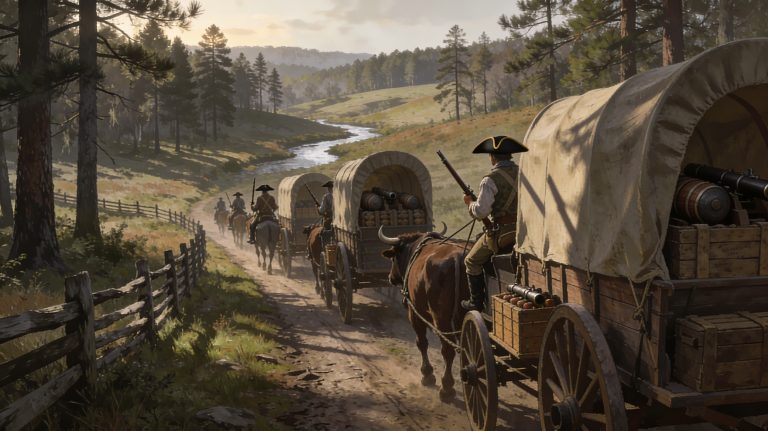
Each of these battles, whether clear victory or costly stalemate, chipped away at the core of Cornwallis’s army. Men, horses, and wagons were lost faster than they could be replaced; the Loyalist support he had counted on proved fragile and uncertain. By the time Cornwallis turned north into Virginia, he was driving a force already frayed by two years of marching and fighting from the Carolina swamps to the high ridges of the backcountry.
The Southern Campaign had not broken the rebellion—it had hollowed out the very army assigned to do it.
When Cornwallis entrenched at Yorktown in 1781, he brought with him the scars of Camden, the shock of King’s Mountain, the rout at Cowpens, and the attrition of every skirmish and siege in between.
Surrounded by Washington and Rochambeau on land and bottled up by the French fleet at sea, his depleted regiments could no longer fight their way clear. The surrender at Yorktown was not an isolated stroke of fortune; it was the direct result of a Southern struggle that had drained his strength, battle by battle.
Then same Private Jennings who was at Camden, was also at Yorktown:
He [Jennings] further states that he entered the service for another three months tour under Capt Gaines about the 24 or 25 of July 1781 from Charlotte County in Virginia.
“From Charlotte we marched to Chesterfield Courthouse thence we beat down James River and were stationed for short times at different places until we were commanded to join Gen’l Washington and Gen’l Lafayette at Little York. We arrived there at the commencement of the Siege [28 Sep] just before the building of the Poplar tree fort which was a little place of security to shelter us when they were firing upon us.
“From that fort we commenced our entrenchments for several days before we could mount any pieces they still firing on us until we got so far that we raised some field pieces and Bomb Batteries. We then began to fire on them and drove them into their forts.“We then worked night and day until we got the entrenchments finished. We surrounded them in the form of a half moon. The French fleet prevented them from escaping down the river.
“We stormed the British redoubts that were about the British forts before they surrendered. Then we continued to get stronger until we surrounded them with our heavy mettle[?]. We advanced so near them that if we could see a small opening we could through [fire?] a rifle ball into the fort.
“The guard was not more than fifty yards apart before they surrendered. Lord Cornwallis surrendered to Gen’l Washington on the 17 day of October 1781[sic: signaled for negotiations on 17 Oct; surrendered on 19 Oct].
“The capitulation was such that they continued in the fort that night. The capitulation was that they were to march out with their colours with all their arms in such a position as though they were going to march through the County.
“The French and American army paraded in rank and file and we were ordered to treat them civilly but look at them as conquered Brothers.
“They marched in front of our army. The British grounded their arms after
they had marched in front of our army we then took them into our possession and the 19th [British 19 Regiment of Foot] marched them to Winchester.“I marched a few days with the army when my time of service expired and I was discharged.”
In short — Yorktown broke Britain’s political will to continue the war in America, but soldiers on both sides kept fighting for another year or more.
The most tragic chapter in the backcountry of South Carolina’s internal civil war, was yet to take place.
It would unfold in the footprint of Saluda County.

- Royal Jennings was the brother or first cousin of Hezekiah Jennings, 3rd Great- Grandfather of Amy Potts, author of this article. The excerpts provided were part of his testimony in support of his pension application for service in The Revolutionary War. Royal was a resident of Grainger County, Tennessee at the time he offered this account. ↩︎