Part 21: The Bloody Scout
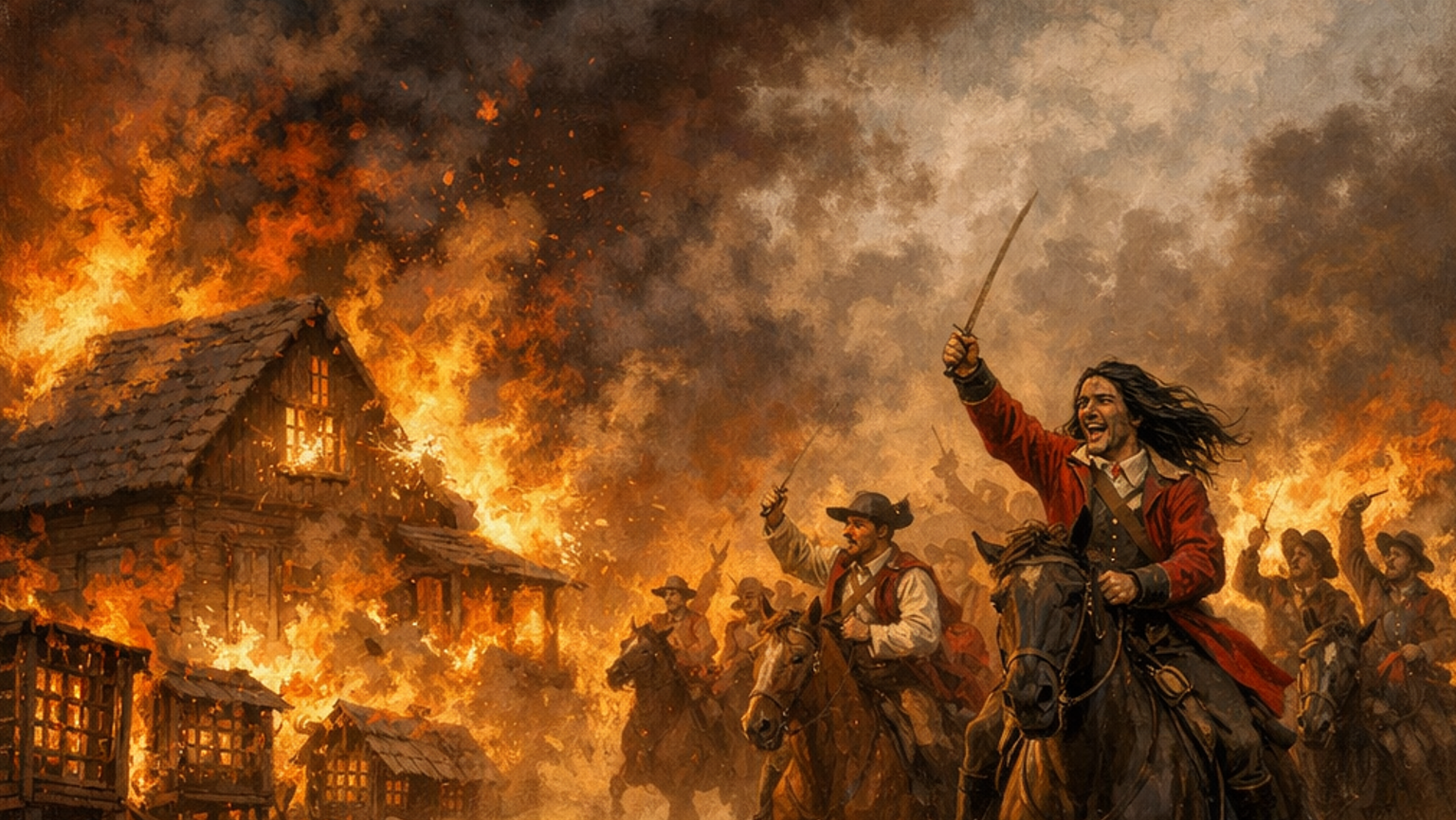
After the slaughter at Clouds Creek on that November morning, William Cunningham and his three hundred Loyalist horsemen rode away from the Carter’s Cabin where twenty-eight Patriot militiamen lay dead.
Cunningham’s column moved north through the pine woods, their horses’ hooves churning the red clay of the Ninety-Six District. They had come for revenge, and this first taste had only sharpened their hunger.
By the next day they had reached the Saluda River. They moved toward the village of Ninety Six along the southern bank until they came to the farm of the old patriot, Dannett Abney, just under Higgins Ferry.
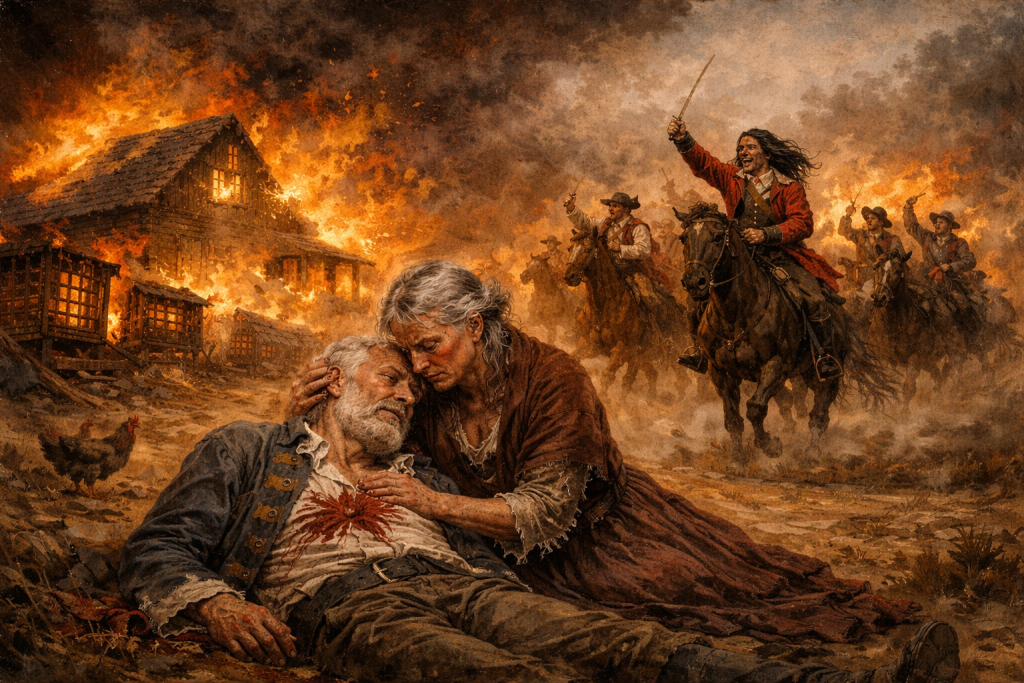
Abney was sick in bed that morning, too weak to rise or run. When Cunningham and his horsemen thundered into his yard, his wife Cassandra rushed out to meet them, pleading for mercy. Cunningham’s men dragged Abney from his sickbed and held him upright in her arms while they cut him down. He died there, still clasped to her breast, his blood soaking her dress. They burned the house, the barn, the cribs of corn—everything that would catch fire. The charred remains of those cribs were still visible decades later, a blackened scar on the land.
Next was the home of Captain John Towles, a former comrade of Cunningham’s who had lately been driving Loyalist families from their farms. Towles was not in the house, but a local turncoat, Ned Turner, suspected he was hiding nearby. With a false promise of protection for his father, Turner convinced Towles’s young son to fetch his father. The boy returned with his father walking behind. Without hesitation, Turner shot Towles dead in front of the child.
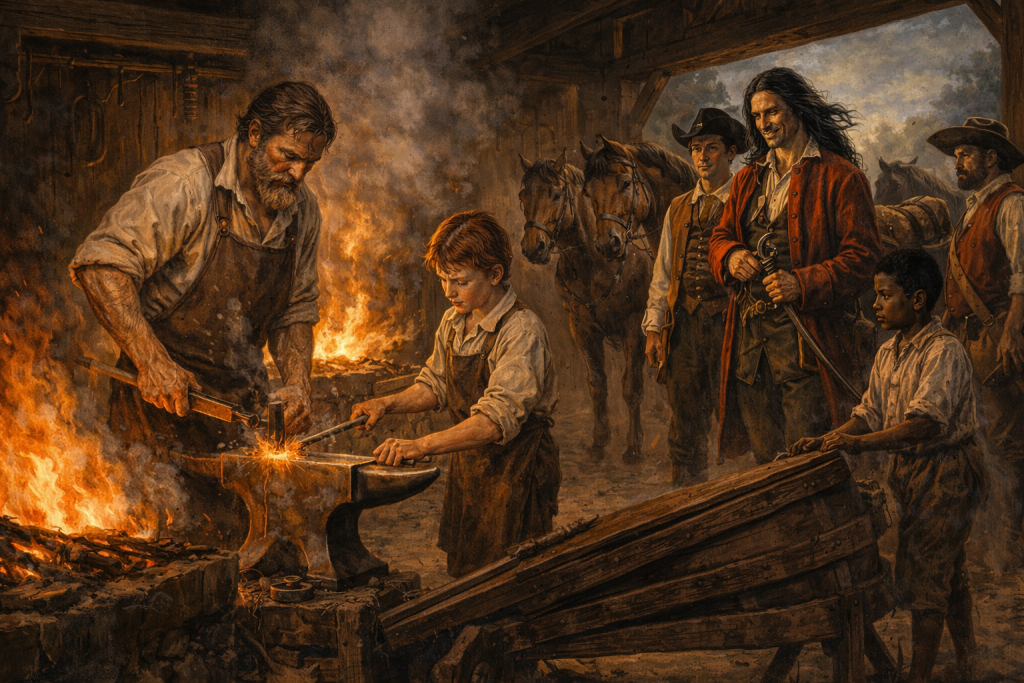
A few miles farther they reached the blacksmith shop of John’s brother, Oliver Towles, whose son was with him. Towles shod several of the Loyalists’ horses. As soon as he was done, the smith and his son were dragged out and murdered alongside an enslaved boy who worked the forge.
That same afternoon Cunningham and his riders came to the gate of Major John Caldwell. Caldwell was Cunningham’s captain in the early days of the war. He was the one who ordered William whipped for desertion – the very same lashes that turned Cunningham Tory. When the major stepped out of the house and onto his porch, Cunningham himself called to him from the road. As Caldwell walked forward; a pistol of one of Cunningham’s men cracked, and Caldwell fell dead at his wife’s feet.
Some said Cunningham wept afterward and claimed the shot had been fired without his order. Others swore he laughed. In either case the house was set ablaze, and the widow was left standing beside her husband’s body with nothing but the clothes on her back.
The next morning, November 19, the raiders reached Hayes Station, a stout blockhouse ten miles away in the Little River District. Colonel Joseph Hayes and twenty-odd Patriots—women and children among them—were inside. Cunningham demanded surrender. Hayes refused, believing reinforcements were near. The Loyalists set the roof alight with a flaming ramrod tipped in tar-soaked flax.
When the smoke drove the defenders out, Hayes offered to surrender if the women and children were spared. Cunningham agreed, then separated the families and hanged Hayes and two young Williams brothers—Daniel and Joseph, sons of a fallen Patriot Colonel James Williams—from the pole of a fodder stack. When the pole snapped; the three men tumbled to the ground still alive. Cunningham waded in with his sword, hacking them to pieces while they screamed. He kept slashing until his right arm grew too weak to lift the blade.
The rest of the prisoners were then given over to Cunningham’s men, who killed them at leisure. By nightfall eighteen bodies lay mangled beside the smoldering blockhouse.
Cunningham’s column moved north again, burning mills and ironworks as they went. At Walnut Grove they dragged a wounded Patriot officer, Patrick Steadman, from his sickbed and murdered him where he lay; two of his comrades who tried to flee were shot down in the yard.
Along Lawson’s Fork they hanged or shot James Wood in front of his wife, then killed his brother John, Hilliard Thomas, John Snoddy, and a man named Lawson as they stepped from their own doorways.
Wofford’s Iron Works went up in flames.
In the Spartan District they cut down Lieutenant Colonel Edward Hampton at the breakfast table, shot James Knox and Thomas Dunlap in their yards, and nearly caught John Boyce, who escaped only by running through the Tory horses and taking a saber cut across the hand.
Detached parties fanned out. One under Captain John Crawford rode west into the Long Cane settlements near the Savannah River. They murdered George Foreman and his two sons, burned Colonel Andrew Williamson’s abandoned plantation at White Hall, and later turned captured Patriots over to the Cherokee for torture.
The main force kept moving, leaving a trail of burned houses and fresh graves. By late November the backcountry was in full alarm. Patriot captains John McClure, John Barry, and Christopher Casey took the field. General Andrew Pickens, himself, raised a pursuit.
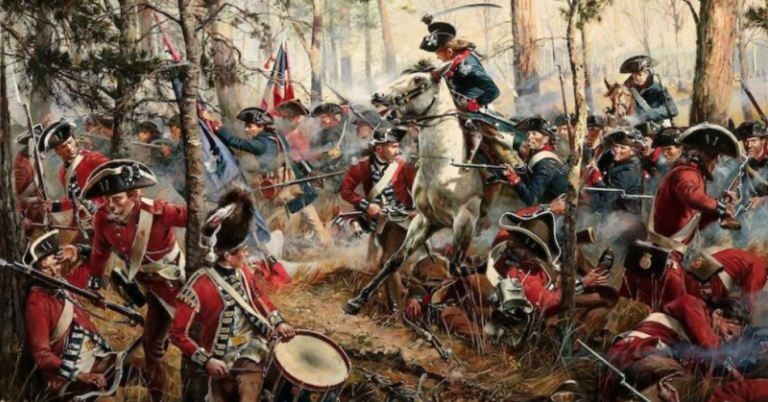
Cunningham split his command into small camps to confuse the hunters. On the night of December 19 he camped along the Edisto River. The next morning Pickens struck one of the camps near Orangeburg and slaughtered every man in it. The alarm saved the rest. Cunningham and about two hundred survivors slipped away through the swamps toward Charles Town.
The killing spree was over, and William Cunningham was gone forever. From that time until this, that violent rampage has been known as “The Bloody Scout” and Cunningham has been known as “Bloody Bill.”
In a little more than a month “Bloody Bill” and his men had killed an estimated seventy-nine Patriots—some in battle, most in cold blood after surrender. They had burned homes, mills, and forges from the Little Saluda River to the Pacolet.
Afterwards, Cunningham retreated to Charleston, where he got a hero’s welcome. Later in 1782, as the British prepared to evacuate, South Carolina’s government confiscated his property in what is now Saluda County. He was named among the “notorious offenders” they aimed to capture if possible.
Cunningham spent a few more years as a Loyalist exile and coastal outlaw in East Florida. He was kicked out twice by the Spanish, and finally journeyed to the Bahama’s with his cousin Robert Cunningham, whose property – now under Lake Greenwood – was also confiscated.
“Bloody Bill” never faced formal American justice for what he had done along the Saluda and Little Saluda Rivers.