The Story of Red Bank Baptist Church
Saluda’s Oldest House of Worship
Churches have from the beginning played an important role in the history of Saluda County. This will begin a series of articles on these churches. We begin with Red Bank Baptist Church which predates the town and county by over a hundred years.
In February 1784 when Red Bank Baptist Church was organized, the land surrounding it was virgin forest. The homes scattered about in this corner of what was then Ninety Six District were those of early settlers who were predominantly farmers. They had settled here as part of a great migration coming down from the north, many of them on the Pennsylvania Wagon Road.
Few records tell of this earliest time. It is very likely that a good spring with abundant water was a deciding factor in its location. This spring had been a stopping off place for Native Americans and weary travelers moving through for many years. It was located a short distance from the present church building in the grove of oak trees on the church grounds.
To place the founding of Red Bank in its historical context, the Revolutionary War was, for all intents and purposes, over by 1782. Many battles had been fought in the Ninety Six District. The notorious Bloody Bill Cunningham had spread havoc throughout the region. The Clouds Creek Massacre had taken place in November of 1781 in which Cunningham and his men had murdered a number of men from the Mount Willing area; among the dead prominent men of the Butler family. The year 1782 found Cunningham leaving Charleston and coming back one more time into the Ninety Six District where he clashed with William Butler of the murdered Butler family.
A deed shows that on September 18, 1784, Thomas Dozier, a deacon in the church, gave land to Red Bank. Little is known of him. He died on July 4, 1785. During this time members of the church met in good weather in what was called a “brush arbor,” having no permanent structure built for worship. When the weather was bad, as in the winter, the congregation met in homes of the membership.
In the spring of 1791, having been inaugurated in 1789 as the first president of the newly formed United States, George Washington set out on a tour of the southern states. His intent was to recognize the part they had played in winning independence. His route took him as close as the Ridge Spring area where he spent the night in the Jacob Odom House before heading on to the new capital of South Carolina in Columbia.
In December of 1802, under the leadership of Thomas Dozier, a deacon, Red Bank was incorporated. Around this time a crude log structure was built to house the congregation, but little concrete information exists about this building.
It was during these early years that two young men, who would go on to fame, were members of Red Bank. William Barret Travis, commander of the Alamo when it fell in 1836, was born in what is now Saluda County in 1809. He lived with his family within four miles of the church and was a member until 1818 when his father, Mark Travis, requested a letter of dismissal in order to take his family to Alabama. The other young man, James Butler Bonham, was born near Red Bank and not far from his friend Travis. He, too, would die defending the Alamo, leaving his grieving mother, Sophie Bonham, a faithful member of Red Bank who is mentioned several times in the early minutes of the church.
Finally in 1856 a wooden framed building was erected. It faced Bouknight Ferry Road which runs behind the present church. This road was a main thoroughfare from the ferry which crossed over the Saluda River just below Kempson’s Bridge on Highway 375. It headed on toward Johnston, going past the Pine House and on to Hamburg, which later became North Augusta. A note of interest: historical records state that it was at this ferry, then called Lorick’s Ferry, where Bloody Bill Cunningham swam his horse across the Saluda River and fled on horseback to Charleston to escape from William Butler who was in hot pursuit. It would not be too difficult to conjecture that Cunningham might have passed down this road very near to where Red Bank Church would soon come to be located.
The first service held in the new church building remembered Rebecca Edwards who had died in September of that year. Many in Saluda remember her great granddaughter, Mrs. Sallie Black, who was a life-long member of Red Bank. Mrs. Edward’s husband, Jarrott Edwards, fought in the Revolution.
Before the Civil War, Red Bank had a sizable black membership and records show that some of them, like the Mobleys and the Doziers, took leadership roles as deacons. After the war in 1871, the black congregation withdrew from the church to form Pleasant Hill Baptist Church. Records show that Red Bank was willing to help them with establishing a church of their own and 182 members were granted letters. Some of them formed Rock Hill Baptist Church at the same time.
In the early 1890s there were some living in the Edgefield District who wished to have a county of their own. Mr. B.W. Crouch was chief among them, and he began to work tirelessly toward that end. He went in his buggy from house to house in this rural agricultural region collecting 1700 signatures of men on a petition that advocated for the new county. Women were not included because they couldn’t vote.
In 1894 then Governor Ben Tillman called a Constitutional Convention beginning in September 1895. His purpose was to create a new constitution for South Carolina. At that time, with much wrangling and behind the scenes manipulations, Saluda became the only county in South Carolina created at a constitutional convention. On October 31, 1895, the ordinance was passed and the new county was born.
It was then that Red Bank entered the picture. The newly appointed commissioners for the county had much to do. Surveyors had to draw the official boundaries and a county seat had to be placed. Tillman decided that a stake should be driven at the geographical center of the county and that the county seat should be within three miles of the stake. Three sections wanted this distinction: Emory, Mickler, and Red Bank; all were within the three-mile requirement.
What followed was a contest that pitted the inhabitants of these communities against each other in what B.W. Crouch called a “warm campaign.” In the first vote held on April 1, 1896, Mickler received the low vote and was eliminated. Both Emory and Red Bank published newspapers during this time extolling the worthiness of their areas. The Red Bank Courier proclaimed that Red Bank “would be willing to give ground for the public square, all the streets, and the erection of the courthouse and jail free of cost to the people of the county.” They even published a drawing of the proposed courthouse building. The final vote on April 14, two weeks after the first, saw Red Bank narrowly win by a vote of 931 to Emory’s 843. Red Bank’s offer stipulated that the court house would be constructed within 400 yards of the church and so it was and so the town of Saluda was born out of virgin forest.
On July 28, one of the hottest days anyone could remember, the cornerstone for the courthouse was laid with great pomp and ceremony by the Grand Officers of the Grand Lodge of Masons. It must have been a bit messy because soot and ash were everywhere from the cutting and burning of trees to clear land for the streets to be laid out. B.W. Crouch reported that fully 5000 people from near and far gathered in the grove at Red Bank to hear George D. Tillman, brother of Ben, give the keynote address. A free barbecue was provided consisting of 100 carcasses which were cooked over an open pit down in the grove.
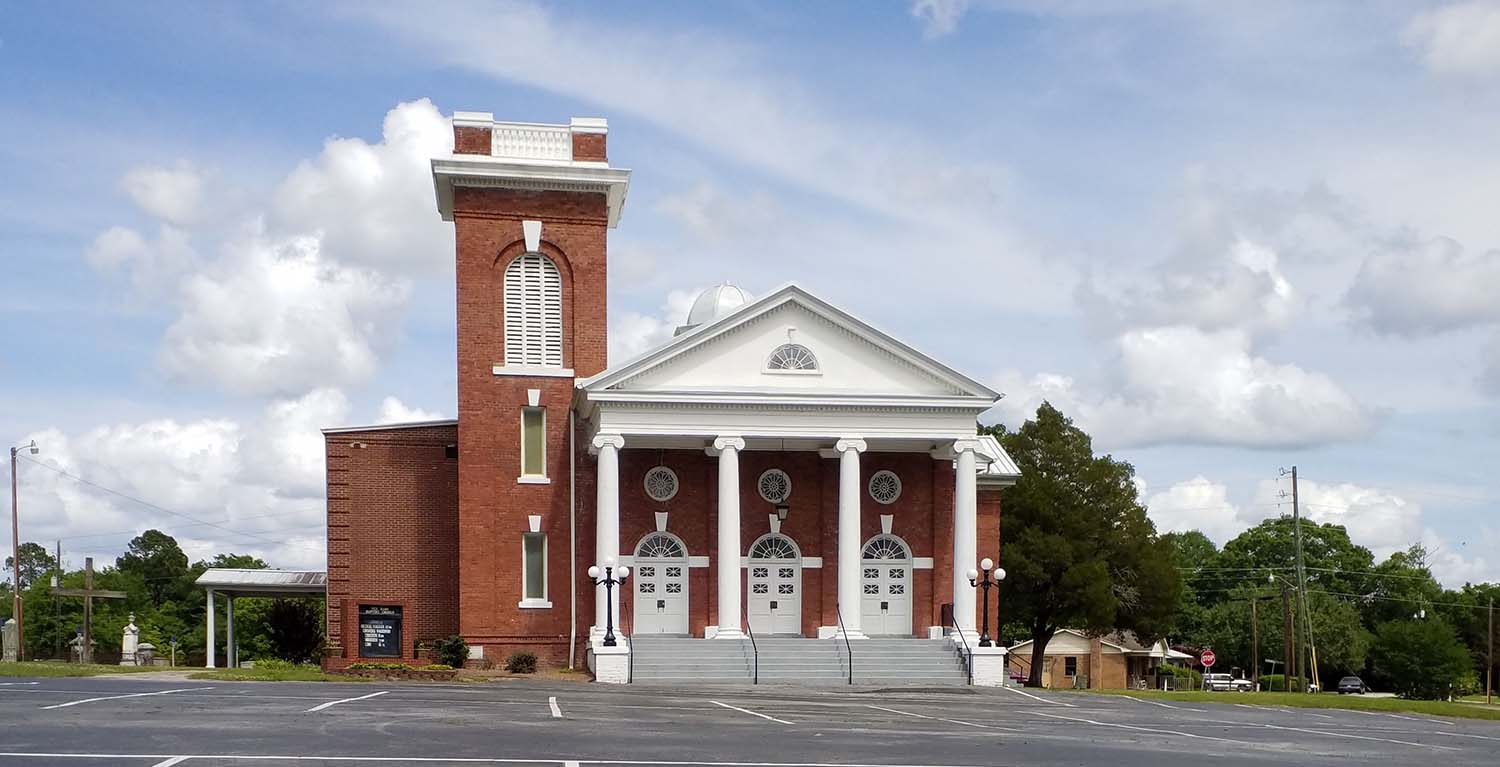
Just 14 years later in July of 1910, the Saluda Standard published an article entitled “Baptist to Build Handsome Church.” It read:” On last Sunday Red Bank decided to move forward and begin the erection of her new building at once. The plans furnished by an architect and adopted by the church call for a handsome brick building with colonial exterior. The interior will be modern in every respect, besides having a commodious auditorium and Sunday school apartment will be furnished with ten separate class rooms and galleries. The building will be one of which the town, community and future generations may be justly proud. The church will be built by the voluntary contributions of her members and friends. The pastor, Rev. J.E. Bailey, earnestly pleads for the hearty cooperation of every one.” There would be a change in the location of the new church, however. Red Bank made an about-face, and the new building would face up the hill toward the growing town.
In August 1912 the Saluda Standard again reported that “The Baptist Church, which will be one of the most handsome church buildings in this section of the state, will be ready for use now shortly. The outside work is practically complete and the inside will be ready upon the arrival of the seats. The contract for lighting has been awarded to Mr. W.J. Hatcher of Johnston. The church will be lit with acetylene gas lights. Built of bricks made of local red clay and fired in Alvin Etheredge’s kilns, the church is uniquely Saluda’s in its design and construction.”
Interestingly, the construction of Red Bank was part of a building boom in Saluda. Many other buildings were taking shape, including Saluda’s only skyscraper, the Able Building. In fact, a number of the buildings that still line the town’s streets were constructed in and around this time.
A grateful congregation moved into its grand new Red Bank Baptist Church in 1913, and this new building would continue to be a center for social and religious activities as the twentieth century progressed. Other churches built within the city limits as the town grew. The Methodists established St. Paul and the Lutherans, Mount Pleasant. A little later the Presbyterians built a fine brick edifice for their services. Red Bank remains the only church in the city limits that has its own cemetery, probably because for a hundred years it was a small country church in the woods like so many others that were organized to serve the people of their communities.
In 1941 the sanctuary was expanded and by 1949 the congregation recognized the need for additional space for a social hall, offices, and Sunday school rooms. As a result a new two-story wing was added to the existing building.
The year 1968 saw another change as a sister church, Saluda Baptist, formed from some of the Red Bank membership. With the passage of time, many changes have altered Red Bank—births, deaths, wars, even differing ideologies—but the church lives on in this twenty-first century. Its iconic presence, as you look down the hill from town, has been a landmark much longer than anyone living today can remember. From a faithful few meeting in a brush arbor in an early American wilderness, to a crude log cabin, to a sturdy small wooden church house, to the beautiful brick edifice it is today, Red Bank Baptist Church still stands as a testament to all the people who have worshiped on this piece of ground for more than 233 years.

