Saluda County and its Courthouses
Saluda County (452 square miles; 2000 pop.–19,181), created in 1895, is the only county formed by the action of a South Carolina Constitutional Convention. The area had been first a part of the royal colony, then of Ninety Six District (1769-1785), of Edgefield County (1785-1800), of Edgefield District (1800-1868) and from 1868 to 1895, of Edgefield County when the area was redesignated a county.[1]
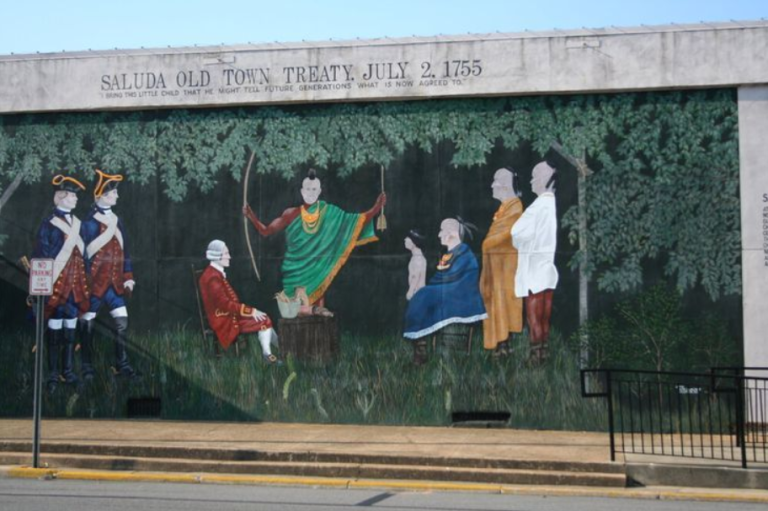
When this area was still a royal colony, at Saluda Old Town, about ten miles north of present-day Saluda, on July 2, 1755, Governor Glen obtained from Old Hop and other chiefs of the Cherokee nation the cession of the territory embraced by the present counties of Spartanburg, Cherokee west of Broad River, Union, Newberry, Laurens, Greenwood, Abbeville, McCormick, Edgefield, Saluda, and a part of Aiken. This treaty opened up the whole upcountry for settlement, and at that time people from Pennsylvania, Maryland, Virginia, and North Carolina, as well as many from Europe settled in the area. Many of the present citizens of Saluda County have ancestors who came to this area in the second half of the 1700s. [2]
B. W. Crouch in Scraps of Interesting History stated: “Between 1760 and 1830 much of what is now Saluda County had been settled. These pioneers came from Maryland, Virginia, and some from Pennsylvania. They were noted for their independence and public spirit….The Indians were gone, much of the land was fertile; there was plenty of game—including deer; in the rivers and small streams fish abounded.” [3]
The area that is Saluda County today was home to many national leaders: General William Butler of Revolutionary War fame; Andrew P. Butler, judge and U.S. senator; Pierce M. Butler, governor and colonel of the Palmetto Regiment; Milledge Luke Bonham, general and governor, and the Alamo martyrs James Butler Bonham and William Barret Travis. [4]
The people on the east side of Edgefield County wanted a county of their own because they were so far from Edgefield, the seat of government. Three petitions from 306 citizens of the east side of Edgefield County requested that the legislature divide Edgefield County to create a judicial district with the courthouse located on the waters of Saluda River. [5] All three failed, and the area remained a part of Edgefield County until 1895 when the petitioners had Ben and George Tillman on their side.
The problem was that the brothers disagreed on the name. Ben insisted on “Saluda” because of the county’s location on the Saluda River, and George insisted on “Butler” to honor the illustrious leaders of the Butler family. On Friday night when Ben Tillman left for home, the name was to be “Saluda”; however, on Saturday George Tillman maneuvered the convention into changing it to“Butler.” On Sunday night when Ben Tillman returned, he was furious when he was furious that the name had beenchanged. B. W. Crouch, a delegate and friend of both men, wrote of the “charges and countercharges” of the delegates as they fought over the name, and he reports that on the amendment to “remove the name ‘Butler’ and insert the name ‘Saluda’ in the Ordinance to Create the County passed with 80 yeas and 54 nays.” [6]
The ordinance that created Saluda County mandated that voters choose a site for the county seat “within three miles of the geographical centre of the County.” Any community in that three-mile radius could nominate itself. Then voters would select the site from the nominees.[7] Red Bank, Mickler, and Emory were vying for the site, and in the first election Emory received the most votes but not a majority. In the second election, Red Bank won by 88 votes.[8]
Each of the three communities had presented a plan for laying out the county seat and for building the courthouse. Red Bank had proposed that its citizens would buy six acres of wooded land near Red Bank Baptist Church (founded in 1784) and build the courthouse. The Red Bank Courier, published between the first election and the second, printed a drawing of the exterior of the proposed courthouse and a floor plan of both floors along with the contractor’s specifications and with appeals to the readers to vote for Red Bank.[9] After Red Bank was chosen, the men of the community cut down the trees on the six-acre site and burned them. Then on July 28, 1896, the county celebrated as the Masons in full regalia laid the cornerstone for the new court house. The Edgefield Chronicle gives a detailed account of the plans for the courthouse, of the contents of the cornerstone, of the speakers of the day, and of the meal. The writer says, “A barbeque dinner was served near by and the 5,000 were fed in excellent style. For the dinner there were slain 85 head of sheep and porkers, and many four-horse loads of bread and picnic baskets were utilized.”[10]
Soon county officers were elected, the first court session was held, two hotels opened, people moved to town, and many stores opened for business, and in 1897, the town was incorporated. Although the courthouse was unfinished, the county began functioning as a legal entity on December 1, 1896. [11] Many groups were allowed to meet in the courthouse. For example, Methodists who had moved to Saluda met there until they built their church in 1898. Five attorneys recognized the possibilites in the new Saluda County and came to practice law there.[12] A two-story brick school was built to accommodate the students moving into town.
The coronor’s book for this period records a number of cases tried in the new courthouse. In 1908 the first and only hanging in Saluda County was carried out at the jail behind the courthouse. The defendant had asked a man to lend him his horse and buggy, and when the man refused, the defendant shot and killed him. The defendant was tried at the courthouse and condemned to be hanged at the jail behind the courthouse.[13]
By 1912 the economy was booming, and by 1917, twenty years after the first courthouse was opened, Saluda County’s leaders were dissatisfied with their court house and talked about building a new one. During World War I, Saluda did build a new courthouse.B. W. Crouch had said that the proposed first court house building “costs more than we intended, has more rooms than necessary, but that the Red Bank people determine that if they did offer to build a court house for the people, it should be a first class building.” [14] However, this building was not built as planned. Photographs of the exterior of the building as it was constructed show the same exterior as that of the plan laid out before the election. [15] What was not the same was the lower floor. According to citizens who remembered the building, the lower level had only a dirt floor, not the beautiful heart pine floor that the plan called for.
Davenport Padgett said of the courthouse in 1986: “They built the first courtroom in 1896. The building had a dirt floor downstairs. The courtroom was upstairs just as it is now. The jail was a small, wood building right behind the courthouse. The new courthouse, the one that’s still there, was built in 1917. I was the one that dug up the old rusted cornerstone. It was a tin box—rusted, in bad shape. In it was a whiskey bottle with just about one-tenth of an inch of whiskey in it, a mouth organ, a pocket knife, and a baby diaper. Also some papers, but they were about gone. I was working on the new courthouse, hauling rock and sand. That tin box might have been a lard can, but I know it was all rusted—twenty-one years is a long time to stay in the ground.” [16]
When B. W. Crouch spoke at the dedication of Saluda County’s 1917 courthouse, he said the creation of the county and the building of the courthouse were the first era of the county’s history, the coming of the railroad, the second, and the building of the present courthouse, the third. He added that there had been talk of the necessity of a new court building and the grand jury had made some recommendations in regard to that, but no steps had been taken to that end.
Then he told how a group of men at the courthouse met on a Saturday afternoon to talk about the need: “At this conference….there was no dissenting voice as to the great need of a new court house.” He explained how Senator Griffith and Representatives Daniel and Riley were instrumental in Saluda County’s building a new courthouse. He said that “this building could not be duplicated today for less than $100,000….” He listed the receipts as $62,749.15 from court house bonds, sinking fund commission, and receipts from sale of parts of old court house. He listed disbursements as $60,951.73, which included cost of court house, heating and plumbing, electric work, furniture, architect’s fee, and rent paid for county officers. [17]
Today, this courthouse stands proud and strong with its front portico and columns facing the well-kept grounds. It was damaged by fire in February, 1942. The fire started from an unknown source and did an estimated damage of $20,000. According to an article in The Saluda Standard, “Heaviest damage was done to the offices of the Auditor and the Superintendent of Education, but no valuable papers are reported to have been lost. Other offices on the first floor were considerably damaged by water.”[18]
In 1976 the courthouse had a complete renovation of the first and second floors. During that time the officials had to move to other quarters to carry on the business of the county until the work was completed. For the first part of the twentieth century most of the officers were men, but in recent years many of them have been women. Still, Saluda County is small enough so that the county officers are able to know the citizens of the county. Election night was always an important night at the courthouse. A writer for The State described the atmosphere in 1980: “Even in the 11 p.m. darkness, the Saluda County Courthouse lawn looked like it was ready for a picnic. Older women sat in circles in their lawn chairs exchanging news. Children played Frisbee while babies rocked in their mother’s laps. Many men stood, hands on hips, making their guesses. And everyone was awaiting election returns. One by one, box bearers would park their cars and deliver their results, ‘There comes another one!’ they would yell. Once tabulated, a man recorded the numbers with chalk on a blackboard in the courthouse hall. People crowded around with their pencils and charts, copying the votes to tally themselves….It’s hard to believe that kind of excitement still exists. Along with the spirit of friends gathering, perhaps Saluda has the key to the spirit of democracy.”[19]
Long ago, the janitor who cleaned the courthouse also fed the coal into the furnace in the basement to keep the building warm. One much-liked and well-respected janitor was discovered with a small still there which he used to make his own brand of liquor. [20] The public health nurse and doctor had an office upstairs where they gave typhoid and other vaccinations. In the 1930s and 1940s the smell of the medicines permeated the building. Also the only public rest rooms in town were in the court house, and when people went to town on Saturday afternoons to buy their weekly supplies, they would use these public restrooms.
In 1990, instead of the words “Saluda County Courthouse” across the front of the building, the words “Clarendon County Courthouse” took their place. The courthouse was part of the set of the movie Separate But Equal, which starred Sidney Poitier. The directors brought the cast to Saluda because the Saluda Theater was exactly as it was in 1954, the time in which the movie is set. Therefore, the courthouse was the place where the court case would have been heard. The directors changed the fronts of certain buildings to what was appropriate in 1954, but the most noticable change was at the court house. Everyone who saw the words seemed puzzled or shocked until they learned about the filming. [21]
Today on the courthouse square plaques and monuments celebrate important people or events in the area’s history both before and after it became Saluda County. A mural and a plaque depict the signing of the Saluda Old Town Treaty on July 3, 1755. A plaque commemorates the importance of South Carolina’s Palmetto Regiment, which was led by Pierce Mason Butler, and another monument honors William Barret Travis and James Butler Bonham and their sacrifice at the Alamo. Also a monument honors the memory of “The Sons of Saluda County Who Gave Their Lives for Our Country in the Spanish-American War, World War I, World War II, the Korean War, and the Vietnam War.”
In 1995-96 Saluda County celebrated its centennial with activities which began in the Saluda County courthouse in September, 1995, the month the county was created, and ended in the courthouse in December, 1996, the month the county became operational. As a part of the celebration, the Centennial Commission published Breaking New Ground: A Pictorial History of Saluda County. In “Old Ground” the book records the story of the people before the county’s formation, and in a section called “New Ground,” it tells the story of the people after the county’s formation. To citizens of Saluda County today, the courthouse is a constant landmark in their lives. As children, they went there with their parents, and as adults, they go to register a deed, to pay taxes, to do research, to get a marriage license, to probate a will, to go to court, and for many other reasons. Today the courthouse is still the center of the town and the county.
Footnotes
1. “Edgefield County,” The South Carolina Engyclopedia, Walker Edgar, ed., 2006, 284.
2.Bela Herlong and Gloria Caldwell, eds., Breaking New Ground:A Pictorial History of Saluda County (Saluda, SC: Saluda County Centennial Commission, 2005), 18.
3. Benjamin West Crouch, Scraps of Interesting History and Other Writings, Bela Herlong, ed., (Saluda, SC: Saluda County Historical Society,1996), 10.
4. “Saluda County,” The South Carolina Encyclopedia, Walker Edgar, ed. 2006, 833.
5. SC General Assembly Petition, 1842, No. 122, roll ST1401, Department of Archives and History., (copy in Breaking New Ground, 69); SC General Assembly Petition, 1843, No. 128, roll St1420, frames 191-200, Department of Archives and History; SC General Assembly Petition ND-5191-1, frames 887-881, Department of Archives and History.
6. Crouch, 49-51.
7. Herlong and Caldwell, Breaking New Ground, 72-73.
8. Ibid., 72-73.
9. Red Bank Courier (no editor or author named), March 21, 1896,1-4.
10. “The State’s Baby County,” The Edgefield Chronicle, Aug. 5, 1896.
11. Herlong and Caldwell,80.
12. Ibid., 83.
13. Ibid., 89.
14. Red Bank Courier, 1-4.
15. Herlong and Caldwell, 81.
16. Davenport Padgett, “One’s Man View of Saluda,” Prism, 1986, 48.
17. Crouch, 107-109.
18. “Court House Here Damaged by Fire,” The Saluda Standard, Feb. 5, 1942.
19. Cathy Collins, “People Await Results on Courthouse Lawn,” The State,1980, in
Davenport Padgett, Padgett’s My Name, Bela Padgette Herlong, ed., (self-published) 2008, 505.
20 Billy Coleman, Interview, 3-29-2010.
21. Kindra Wills, “Lights, Camera….Action!” Prism, 1982, 38-39,